

Australia and Deep-Sea Mining
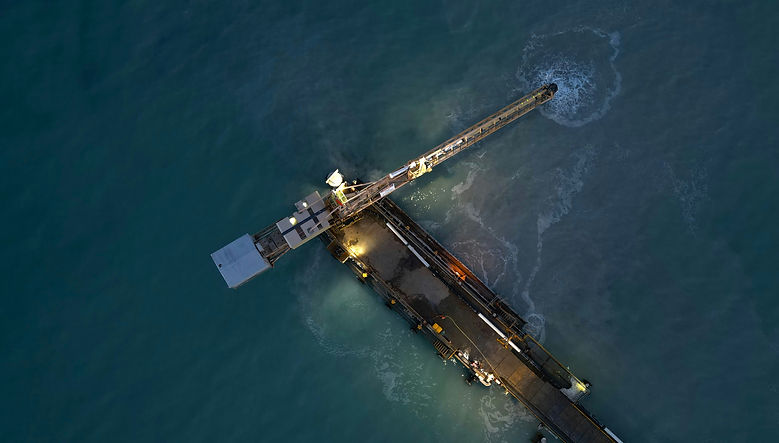
Offshore contractor Allseas and The Metals Company (TMC) plan to launch the world's first commercial deep-sea mining operation by 2027. The project will collect mineral-rich polymetallic nodules from the seabed more than 4 kilometres below the Pacific Ocean in the Clarion–Clipperton Zone (CCZ). These nodules contain metals such as nickel, cobalt, copper and manganese, which are used in batteries, renewable energy technologies and electronics.
Supporters argue that deep-sea mining could provide critical minerals needed for the global transition to cleaner energy. However, various interest groups worry that mining could damage deep-ocean ecosystems that remain poorly understood. Recent research suggests that these nodules may be vital in ocean processes, including the production of so-called "dark oxygen" which sustains the ecosystem.
There are also legal concerns. Because international rules for commercial deep-sea mining are still being developed by the International Seabed Authority (ISA), TMC is seeking approval through the United States, which has not ratified the UN Convention on the Law of the Sea (UNCLOS). Critics argue this could undermine international governance of the oceans.
Australia's Position
Australia has generally supported a precautionary pause (moratorium) on deep-sea mining, aligning with several Pacific Island nations that want more scientific research before commercial operations begin. Simultaneously, Australians are closely involved in the industry:
TMC's CEO, Gerard Barron, is Australian.
Australian company Cobalt Blue Holdings is involved in plans for mineral processing linked to seabed nodules.
Australian-developed technology is expected to be used in refining minerals from the nodules.
CSIRO has helped develop environmental monitoring frameworks for the Clarion–Clipperton Zone.
This creates a tension between Australia's cautious government position and the involvement of Australian businesses and scientific expertise in the sector.
Alternative Sources
Some experts argue that demand for critical minerals can also be met through:
Expanding battery recycling
Developing batteries that use less cobalt and nickel
Improving recovery from existing land-based mines
Reprocessing old mine waste
Building a more circular economy, where products are reused, repaired and recycled
Supporters of these approaches argue they may reduce pressure to open entirely new mining frontiers such as the deep seabed.
Global Responses
Countries such as France, New Zealand, Fiji, Palau and Samoa have supported a precautionary pause or moratorium on deep-sea mining until more scientific evidence emerges.
Meanwhile, companies linked to the United States are moving towards commercial mining approvals, arguing that critical minerals are needed for economic and strategic reasons. Governments globally are balancing environmental concerns, resource security and economic opportunities in different ways.
Questions:
Does the strong focus on protecting the deep seabed place a higher priority on an untouched ecosystem than on environmental impacts from existing land-based mining and resource extraction? How do you see this trade-off?
Does scientific exploration to develop environmental protection standards for deep-sea mining cause harm to the very ecosystem it aims to protect? If so, is that harm justified by the knowledge gained?
Different countries are taking different approaches—some support a moratorium on deep-sea mining, while others are moving towards commercial mining. What can Australia learn from these approaches, and what do you think Australia should do?
Sources:
Muflih Hidayat. UN Law Violated: Allseas Deep-Sea Mining Contract Challenged. Discovery Alert. 18 June 2026. https://discoveryalert.com.au/allseas-deep-sea-mining-unclos-violation-isa-permit/
Global Parliamentary Declaration Calling for a Moratorium on Deep Seabed Mining. https://www.pgaction.org/oceans/call-for-moratorium-on-deep-seabed-mining.html
UN seabed regulator defends authority as mining firms seek to halt inquiry. Climate Home News. 14 July 2026. https://www.climatechangenews.com/2026/07/14/deep-sea-mining-firms-sue-un-seabed-body-inquiry-isa-itlos-metals-company/
Dutch government “legally bound” to act over rogue deep sea mining plans – legal analysis. Greenpeace International. 17 June 2026. https://www.greenpeace.org/international/press-release/84236/dutch-government-legally-bound-rogue-deep-sea-mining-plans-legal-tmc-allseas/
Australian Statement through the International Seabed Authority. https://www.isa.org.jm/wp-content/uploads/2023/03/Australia_Statement.pdf See also: Lucy Cooper. Australia is yet to announce its stance on deep sea mining - should it? ABC News. 10 March 2026. https://www.abc.net.au/pacific/programs/pacificbeat/deep-sea-mining-australia-role/106435856
Ruth Dawkins. Setting the standard: Science helps deep-sea mining decision-makers assess environmental risks and viability. CSIRO. 3 July 2025. https://www.csiro.au/en/news/all/articles/2025/july/science-helps-deep-sea-mining-decision-makers-assess-environmental-risks-and-viability


